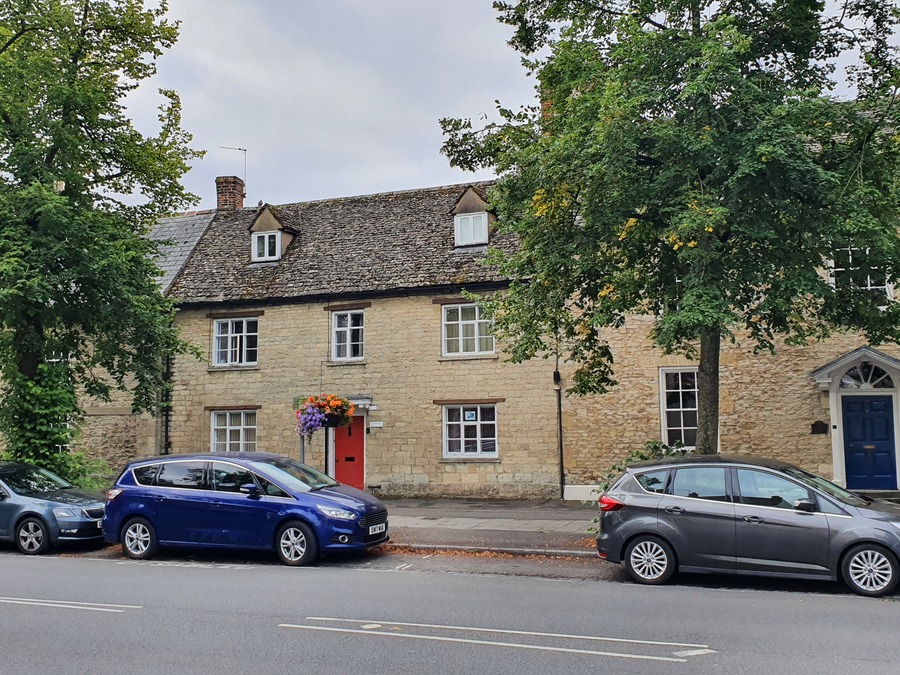
Witney has a long and distinguished history. The earliest written record of the town dates to AD nine hundred and sixty nine, although archaeological evidence shows that the wider area was inhabited in both the Iron Age and the Roman period. Its position near the River Windrush and fertile local farmland made it a natural location for early settlement.
In ten forty four, Queen Emma, the mother of Edward the Confessor, granted the Manor of Witney to the Bishops of Winchester. This grant was later confirmed in the Domesday Book of ten eighty six. The bishops established their residence in the town and built a manor complex close to the parish church. Over time the church at Witney was rebuilt and enlarged, and in twelve forty three it took the form that we recognise today as St Mary’s Church, which still dominates the town’s skyline.
From the thirteenth century onwards, Witney gained prominence as an important centre of the English wool trade. The surrounding Cotswold countryside provided high quality grazing for sheep, and Witney’s cloth produced from this wool became highly regarded. By the early fourteenth century, there were at least five working mills in the town producing blankets and gloves. These early industries laid the foundations of an economic tradition that would shape Witney for centuries.
The organised production of woollen goods continued to grow. By the late seventeenth century, around three thousand people in Witney were employed in the wool and blanket making trades. This represented a large proportion of the town’s population and highlights how central textile manufacture had become to local identity and prosperity. In sixteen sixty nine, the Early family established their blanket making business in Witney. Over the years this company became one of the most recognised names in the town’s industrial history.
The importance of the wool trade was formally acknowledged in seventeen eleven when the weavers of Witney formed an official guild. They were granted a charter by Queen Anne, which confirmed their rights, responsibilities and standards of craftsmanship. Ten years later, in seventeen twenty one, Blanket Hall was built. This building served as the headquarters of the guild and became the place where finished blankets were inspected and measured. This system ensured that the quality of blankets leaving Witney met an agreed standard, supporting the town’s reputation for excellence both at home and abroad.
The nineteenth century brought new developments. The arrival of the railway in eighteen sixty one, largely supported by the Early family, connected Witney to wider commercial networks. It made the transport of raw materials and finished cloth easier and more reliable, further strengthening the town’s manufacturing base. For generations the name of Witney became synonymous with fine woollen blankets, known across Britain and exported throughout the world.
Although large-scale blanket production declined in the late twentieth century as global textile manufacture changed, the influence of this long tradition remains clear. Many buildings, street names and historic records remind us of the town’s centuries of craftsmanship, industry and community life. Today Witney retains a strong sense of identity rooted in its past, while continuing to develop as a thriving market town in the heart of Oxfordshire.